Visiting the Hungarian Parliament building

One of the most impressive buildings in Budapest is certainly the Hungarian Parliament house. It is perfectly located on the shore of the Danube river, and it is absolutely massive! I think I read it is one of the biggest parliament buildings in the world. I was already impressed during my last visits of Budapest, so this time I wanted to see the building inside… and… luckily, there are guided tours!

The building is from the end of the 19th century, so only a bit older than 100 years, and a perfect example of neo-gothic architecture. The main entrance is on Parliament square, with a huge Hungarian flag and some guards giving a very official character to it… (I miss these guards in Berlin in front of the Reichstag… haha!). There are 3 main areas: the 2 assembly chambers left and right and the Dome hall in the middle. 

The guided tour was very informative and I really liked walking through the building.

Follow me in the neogothic world!

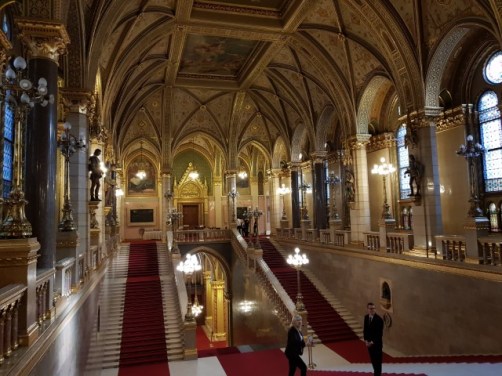
We started the tour walking up the gold staircase and through endless corridors…

We then continued with one of both Parliament chambers. As a little funny detail, the guide pointed at some cigar holders for the members of Parliament where they could leave their cigars while “working” in the chamber, in times when smoking was still allowed.

We passed through some salons…

…before entering the dome room (no pictures!). It is basically a huge decorated room with the pure symbolic function to house the Hungarian monarchy treasures: the holy crown of Hungary, used by all the Kings for their coronation (it’s about 1000 years old in its first version!), the royal sceptre, and the globus cruciger (I had to check that one on Wikipedia… but you know it… it’s the sphere with a cross on it that kings are holding in their hands on some portraits). These items are permanently guarded by 2 guards and every now and now there is a fun guard change ceremony with 2 fresh guards arriving and taking their duty. I thought it’s quite interesting for a parliament building to house monarchial symbols… An interesting detail about the Hungarian crown is that the cross at its top is not straight but crooked! I already noticed that while walking around since the crown symbol is visible everywhere in the city… I didn’t know it was an homage to the real crown! It was damaged in the 17th century and they just kept it that way. I love the idea of having a crooked cross as a national symbol! That makes Hungarian people’s self-irony sense very nice to me!

We ended up the tour walking down the beautiful official staircase.
20190214_130512 (Klein)

It is interesting to notice that – since it’s a recent building – many modern features were implemented, like of course electrical lightning but also elevators, heating and ventilation systems, etc…

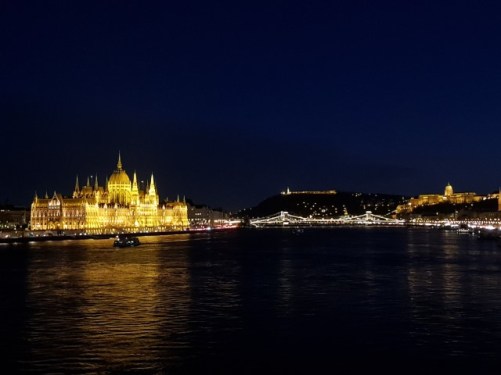
So if you ever visit Budapest, visit the Parliament… and don’t miss the building when it’s lighted up at night… Quite magic!
20190214_174956 (Klein)

A perfect walk on a sunny day – the Buda hills

Disclaimer: I will very often mention historical or cultural facts in my articles. I really don’t guarantee that the information is 100% correct since I have not the pretension to be a journalist. I just like sharing my thoughts and also my knowledge and understanding of local history. So if you are interested in the subject, check on Wikipedia for more accuracy/details.


The name Budapest comes from the names of the 2 cities which merged end of the 19th century: Buda, the hilly and Pest, the flat, separated by the Danube river. The construction of a first bridge (the famous and beautiful chain bridge) helped to unite both sides, but they still have their own identity. Buda is famous for its hills dominating the Danube, and his beautiful castle and viewpoints on Pest. Pest is more the chic city with shopping and fancy elegant cafes.

I spent a beautiful day on Buda side, climbing up and down the hills, and wanted to share a few impressions with you.

The day started with a metro ride from the Pest to the Buda side using the brand-new metro line 4. I was quite impressed by how beautiful and expensive the stations looked like – real concrete cathedrals. I learned from my Hungarian couchsurfer host Peter that the costs were exorbitant and controversial, as often for these big projects. The stations are also very deep, since the line passes a tunnel under the river, and the station Gellert where I got out is just a few meters away from the river shore!

As soon as you get out at Gellert station, you are standing in front of the beautiful Art Nouveau Gellert hotel, also famous for his baths. And that’s where the climb of Gellert hill starts, with his quite steep paths or stairs to get on the top. The vistas on the river and its bridges are really stunning, especially by nice weather, and I couldn’t resist but sat on many benches, enjoying some paprika sausage, smoked cheese and bread every 15 minutes. haha!

At the top of the hill, there is a citadel but also the Liberty Statue commemorating the liberation of nazi-occupied Hungary by the soviets.

 I went down the hill on the other side, having some new views on the Castle Hill and passing by the Saint Gellert monument dominating the hill side.

After walking a bit along the river, it was time to go up again on Castle hill… with an escalator! The 18th century castle which was the palace of the Hungarian kings is quite massive and impressive.

Leaving the castle, you pass by the office of the Prime Minister… an office with a view…  and its cool guards.

The next neighborhood is really pretty… very baroque and has an old town character. It gets busier and busier though, until you suddenly meet thousands of tourists, all gathered behind the Matthias church, at the Fisherman’s bastion. This is I guess the most beloved viewpoint of Budapest, certainly because of its kitschy neoromantic 1900 architecture. I must admit I also enjoy it. It feels a bit like in Disneyland, and the view on the other Disneyland-ish building, the Parliament, is great!

After enjoying the view and the last rays of sun, I went down the bastion’s stairs and finally crossed the Danube like a star, on the scenic chain bridge!